Find it. Make it yours. Save it ready to stitch.
Use the embroidery designs and stitch-file alphabets you already own, from your first search to your finished project.
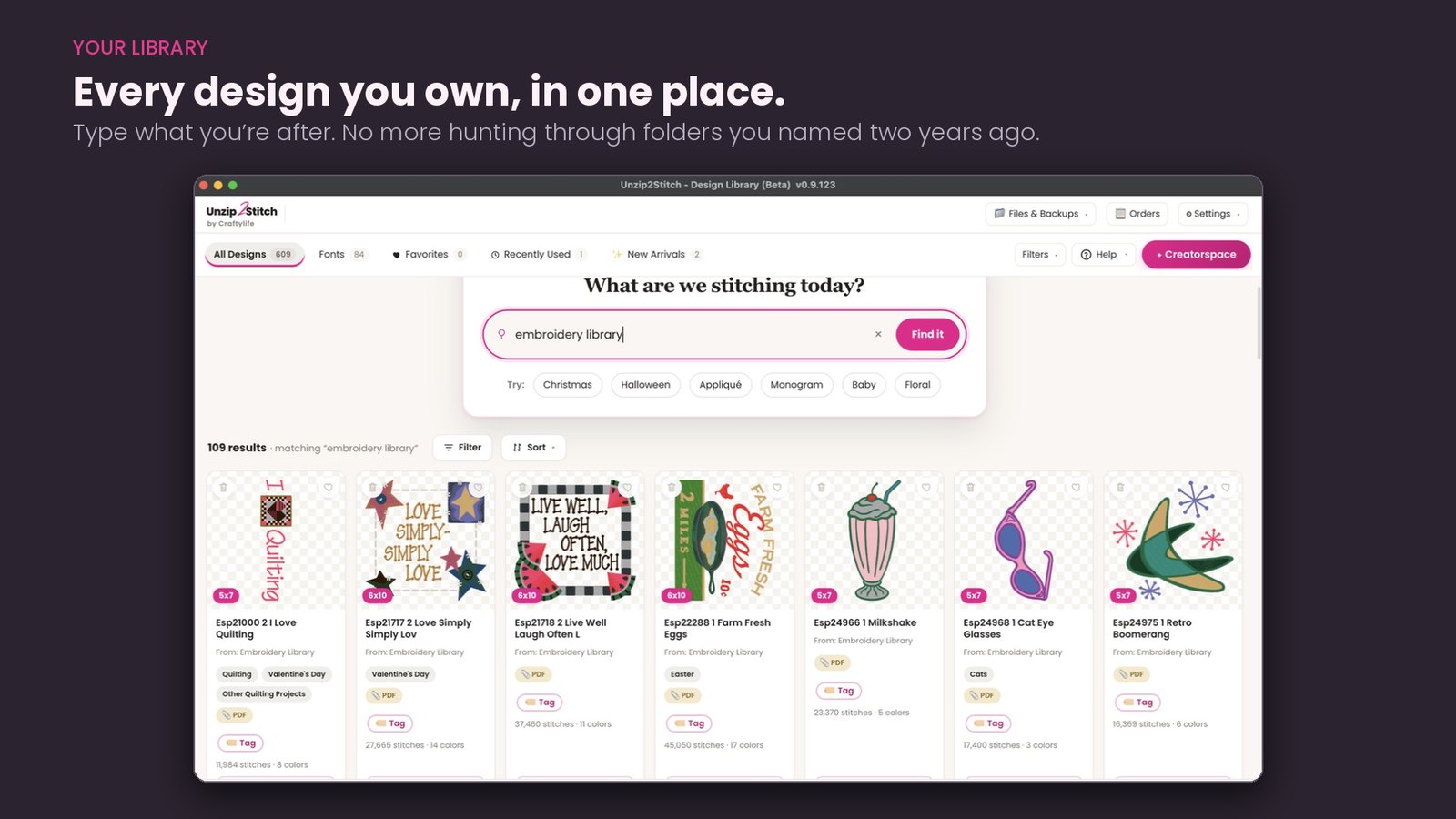
1. Find your design
See your designs as pictures. Search folders and ZIP files, then narrow your choices by hoop size, technique or subject.
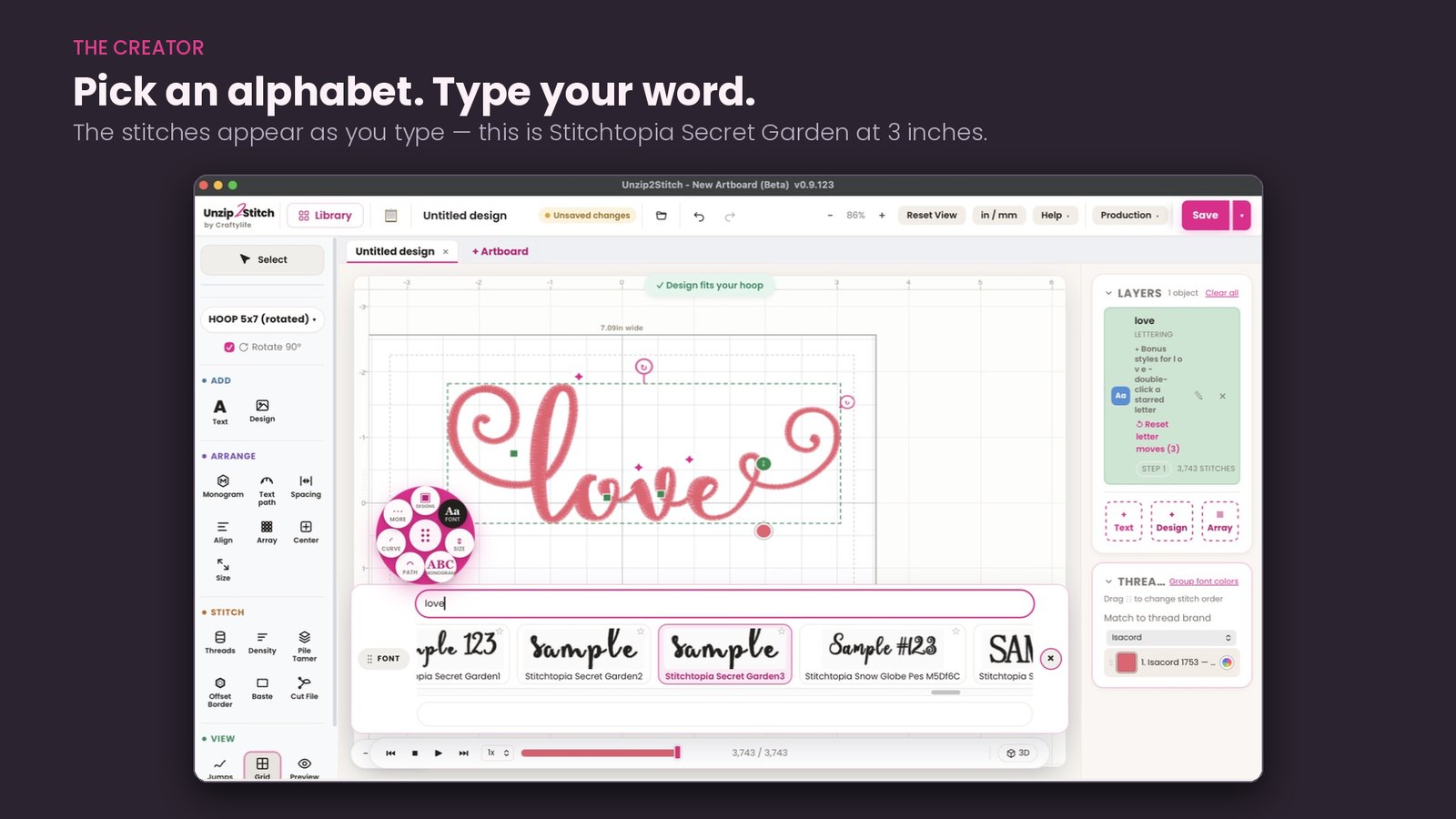
2. Make it yours
Add a name, build a monogram or combine designs. Arrange your project inside your hoop and see it at its finished size.
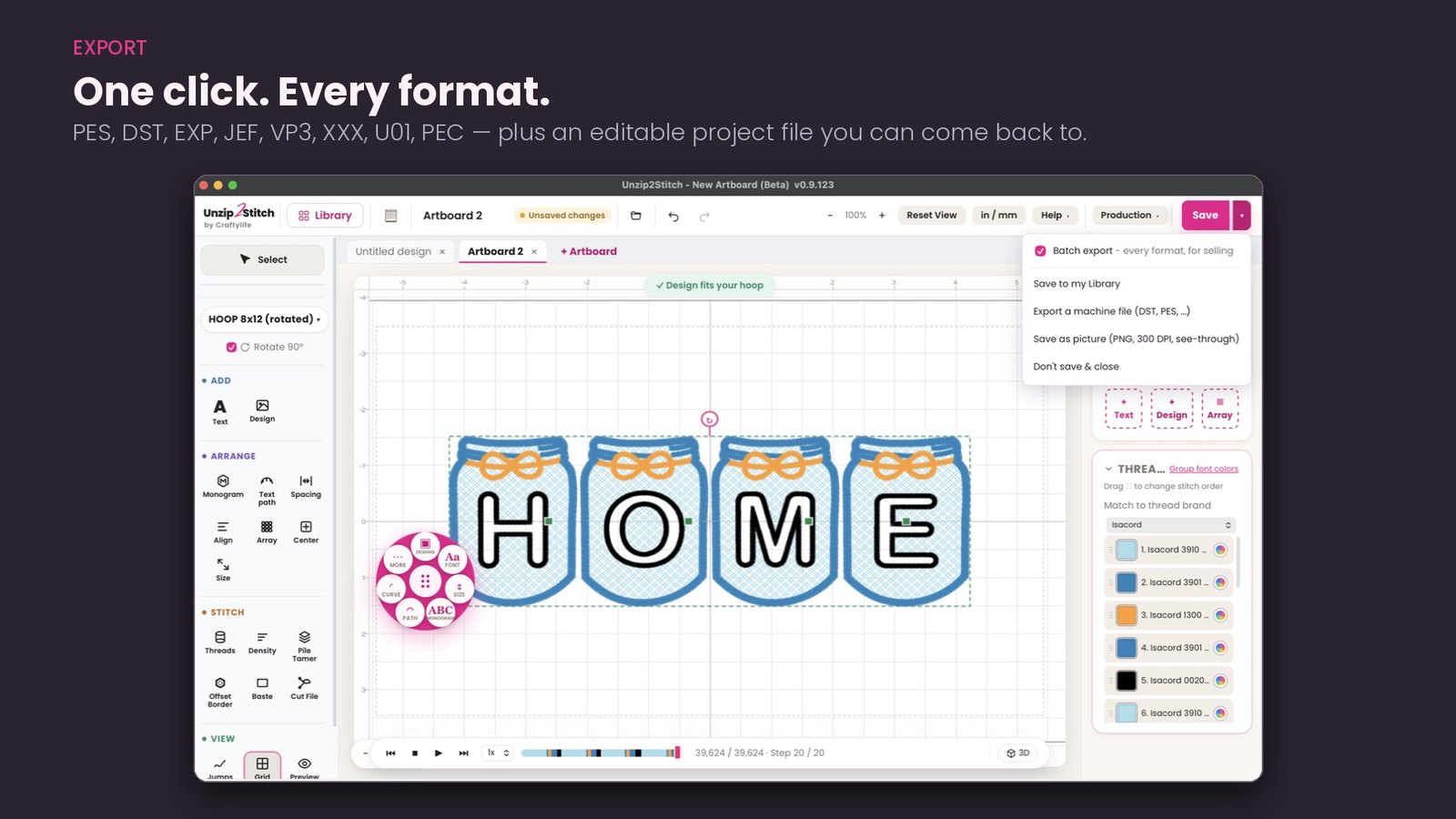
3. Save and stitch
Save in your machine format, including PES, JEF or DST. Keep an editable project so you can return and make changes.
Your original files stay where you keep them. Unzip2Stitch reads designs on your computer and never uploads your embroidery files.
Font compatibility: Type with supported stitch-file alphabets, such as PES or JEF. Third-party formats can be cataloged only; they cannot be used for typing, previewing, or stitching in Unzip2Stitch.
Have artwork that needs digitizing? Unzip2Stitch works with existing stitch files; it does not digitize a logo from scratch. Explore custom digitizing.
Explore the tools when you need them
Choose a topic below to see more. You can start with the basics and explore the advanced tools as you go.
It runs natively on a Mac. Not in a workaround.
Embroidery has spent years being a Windows-only hobby. The usual advice to a Mac owner is to buy Windows, install a virtual machine, and run embroidery software inside a pretend PC on a real computer they already paid for.
Unzip2Stitch is a real Mac app. It is signed and notarized by Apple, so it opens the way anything else on your Mac opens — no security warnings, no unidentified-developer box, nothing to talk yourself past. It runs on Apple Silicon Macs — M1 and newer — on macOS 11 Big Sur or later. If you are on an older Intel Mac, email me before you buy and we will check it together.
And it is the same program on both sides. Windows and Mac get the same tools, the same updates, on the same day. Your license moves with you if you change computers.
Type with supported stitch-file alphabets you already own.
This is the part we are proudest of. We’re not going to claim it’s the biggest font manager in machine embroidery — we’re going to claim it’s the easiest. Supported stitch-file alphabets you already own, ready to type, without a manual.
Bring in supported individual stitch-file alphabets, such as PES, DST, JEF or EXP, straight out of the ZIP. Unzip2Stitch works out which files are letters, which letters they are, and what sizes they were digitized in, and gives every alphabet its own shelf with actual letterforms on the card. Not filenames. Letters.
Then type. The stitches appear as you go, in the alphabet you picked, at a size it was really made for.
Third-party formats are cataloged only. Unzip2Stitch cannot use them for typing, previewing, or stitching — those alphabet installers only work in their own brand’s software. Unzip2Stitch can list them so you know what you own. If your alphabet purchase also includes supported individual letter files, such as PES or JEF, import that stitch-file copy for lettering in Unzip2Stitch.
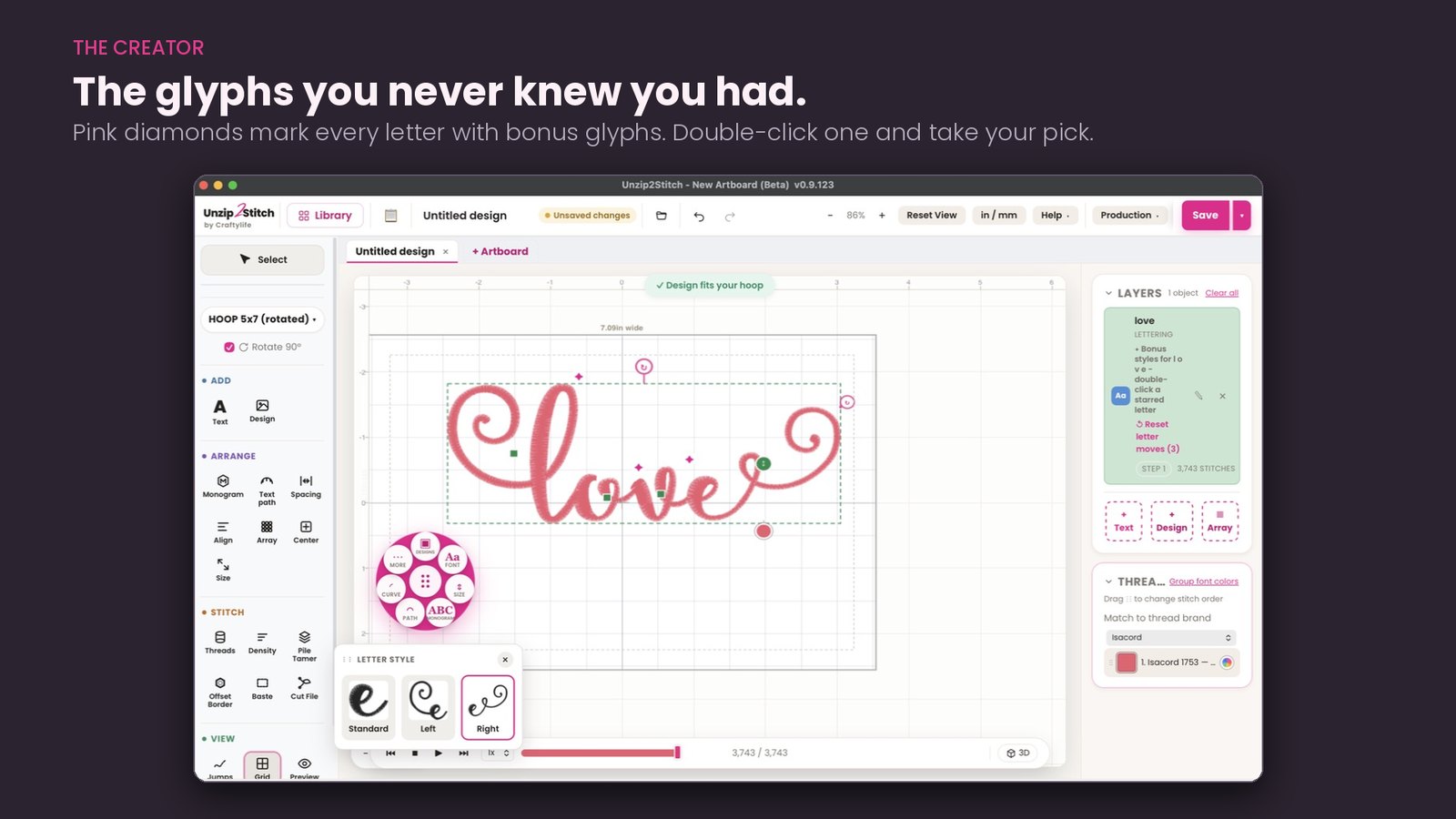
And it finds the glyphs you didn’t know you’d bought. Most script and appliqué alphabets ship with bonus glyphs — alternate letterforms, tails, connectors, beginnings and endings. Almost nobody ever finds them, because they’re buried in the pack. Unzip2Stitch puts a small pink diamond on every letter that has glyphs, right there on the design. Double-click it and take your pick.
Letter it, monogram it, put it on a curve
Curve a name, arch it, set it on a path, space it by hand or by the number. Monogram merging for the three-letter layouts. Fine-tune a single letter without touching the rest. Align a second row to the first. Reset any of it in one click.
Put the name on the design
It’s Tuesday and Billy’s shirt has to be done by Friday. You bought the cake design months ago. You own an alphabet you like. Bring both onto the same artboard, sit the name where you want it, size it to the hoop, and save it out as one file your machine will run.
That is most of what actually gets stitched — a design you already own, with a name on it. Add as many pieces as you like: a design, a name, a date, a border. Layers keep them separate, so you can move any one of them without disturbing the rest.
It is all laid out at true size inside your hoop, so what you see is what stitches. Plenty of programs will show you a design. Plenty will let you type a word. Doing both in one place, and getting one file out of it, is the part you will use every week.
Appliqué, done properly
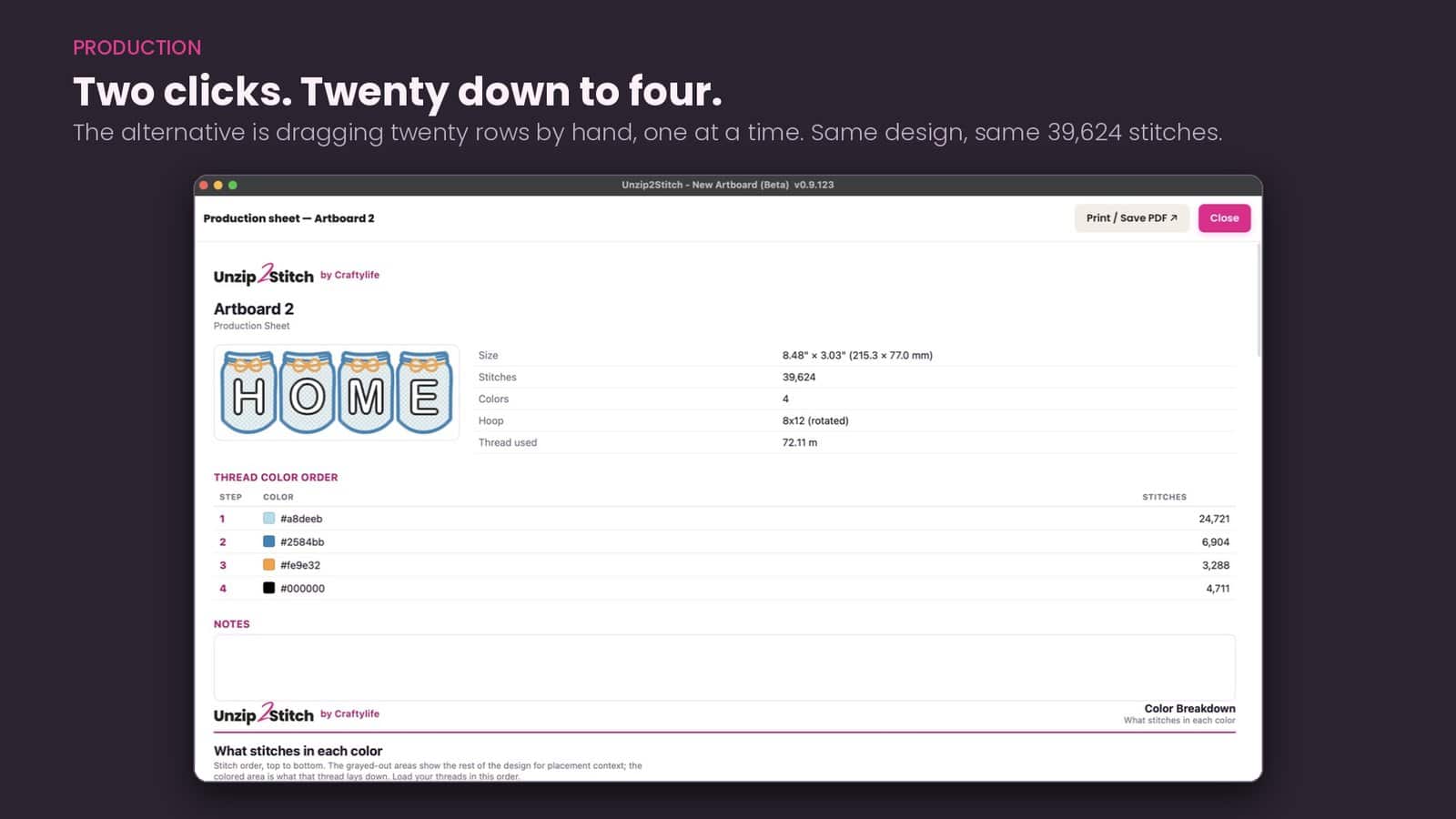
Sort the color order. Four letters in an appliqué alphabet is twenty thread changes by default — twenty stops at the machine. Group the colors and every same-colored piece stitches in one pass: four changes instead of twenty. Same design, same stitch count, two clicks. Doing that by hand means dragging twenty rows one at a time.
Cut your fabric on a Cricut or Silhouette. One click writes an SVG of every appliqué piece, at true size, offset outward from the stitch line so the fabric tucks neatly under the satin border. Adjustable, in sixteenths, for thicker fabric.
Add a satin border set out around the design and following its own shape — seven widths, six offsets.
Every format, in one save
One save writes a file in every machine format Unzip2Stitch can make — PES for Brother and Baby Lock, JEF for Janome, VP3 and HUS for Husqvarna Viking and Pfaff, EXP for Bernina and Melco, XXX for Singer, and DST for commercial machines — from a single save. That’s what you need the day you start selling designs, because your buyers own machines you don’t.
Plus an editable project file so you can come back and change your mind, a 300 DPI transparent PNG for your mockups and listings, and thread colors matched to real brands so your color sheet names thread you can actually buy.
Edit the stitches, not just the picture
Pull compensation — widen every satin column a touch per edge so it doesn’t pinch narrow when the fabric pulls in. Six settings, and it’s the difference between a clean name on a knit and a skinny one. Lighten the density of a fill that was digitized too heavy, up to 10% fewer stitches. Cap the stitch length to your machine’s real maximum so long satins stay whole and smooth. Remove the tiny stitches under a fifth of a millimeter — the snag-prone ones that bunch and break thread.
A density map shows you where the stitches pack in tightest, the spots that pucker or snap thread, before you hoop anything. Pile Tamer lays a light fill first to press the fuzz flat on towels, fleece and minky, so your design sits crisp on top instead of sinking in. A basting box tacks your stabilizer down and pulls straight out afterwards.
Nothing changes your file until you save. Everything is reversible until then.
Know the job before you hoop it
Pick your hoop — 4×4 through 14×14 PR Jumbo, or add your own Mighty Hoop by its real stitch field — and it tells you straight away whether the design fits.
A production sheet you can hand to someone else. Finished size, stitch count, the thread color order in the order you’ll load it, meters of thread per color, and a picture of exactly what each color lays down on the fabric.
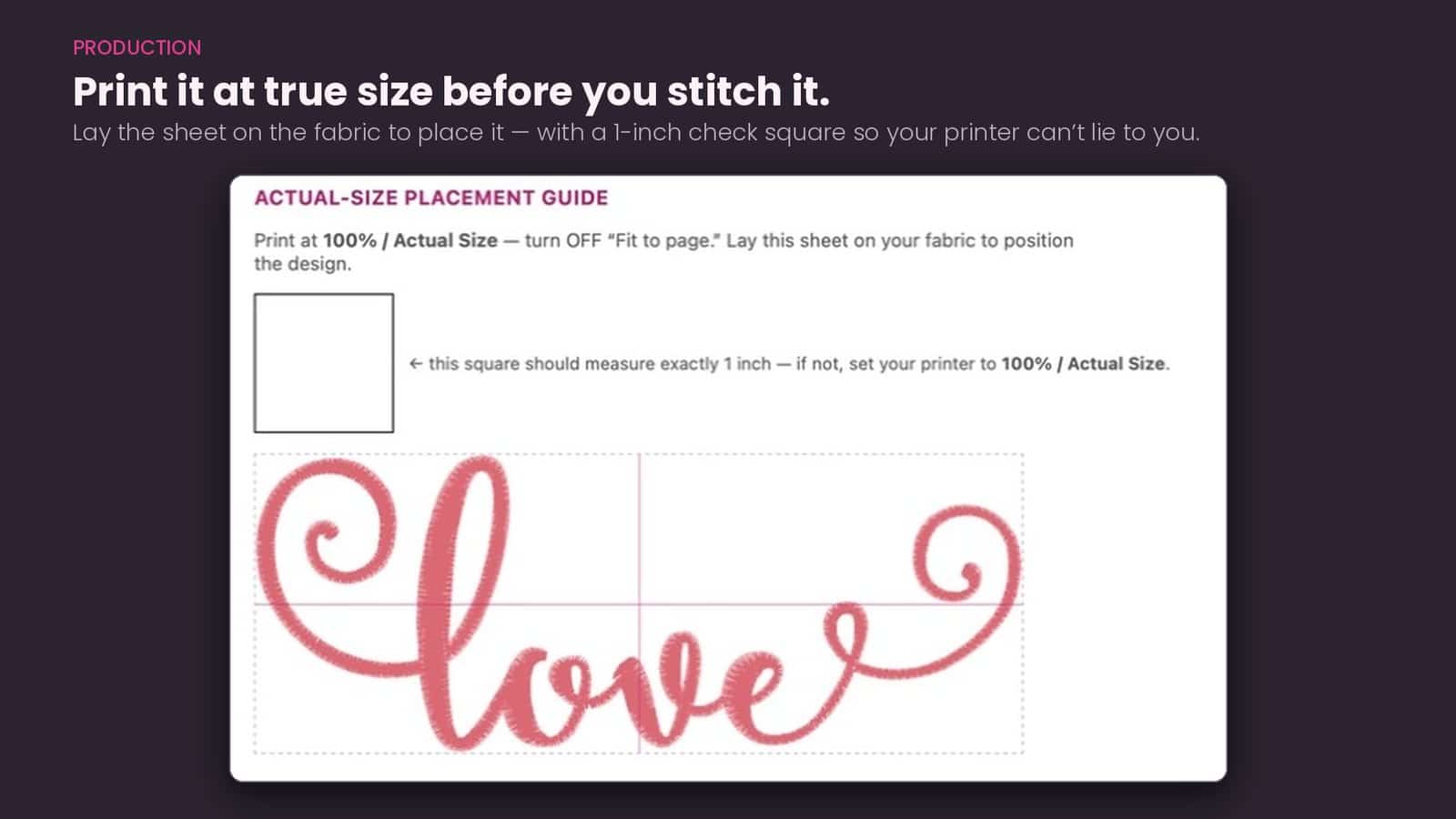
Print it at true size before you stitch it. Lay the sheet on the garment to place the design. There’s a one-inch check square on the page, so your printer can’t quietly shrink it on you.
And a catalog of everything you own
Export your whole library as a browsable, printable catalog — grouped by collection, with a picture and the details of every design, plus a spreadsheet of the lot. Your alphabets get their own list. Handy when you’re deciding what to stitch. Very handy when you’re insuring, inventorying, or just trying to prove to yourself how much of it you already have.
Ready for your next project?
$179 one-time purchase · Normally $249
No subscription · Updates included
Windows 10/11, 64-bit · Apple Silicon Mac (M1+), macOS 11+
30-day software refund policy. View details.
Already use the Free Lettering Edition? Your activation code unlocks the full studio in the same app.
You are not buying from a stranger
I am Lorna. For eight years I have answered embroidery questions every day in Embroidery for Beginners, my Facebook group of more than 50,000 members. Unzip2Stitch was built out of what I watched people there struggle with.
My name is on the digitizing, on the software and on that group. If something goes wrong, you know exactly where to find me — and so do fifty thousand other embroiderers.

Reviews
There are no reviews yet.